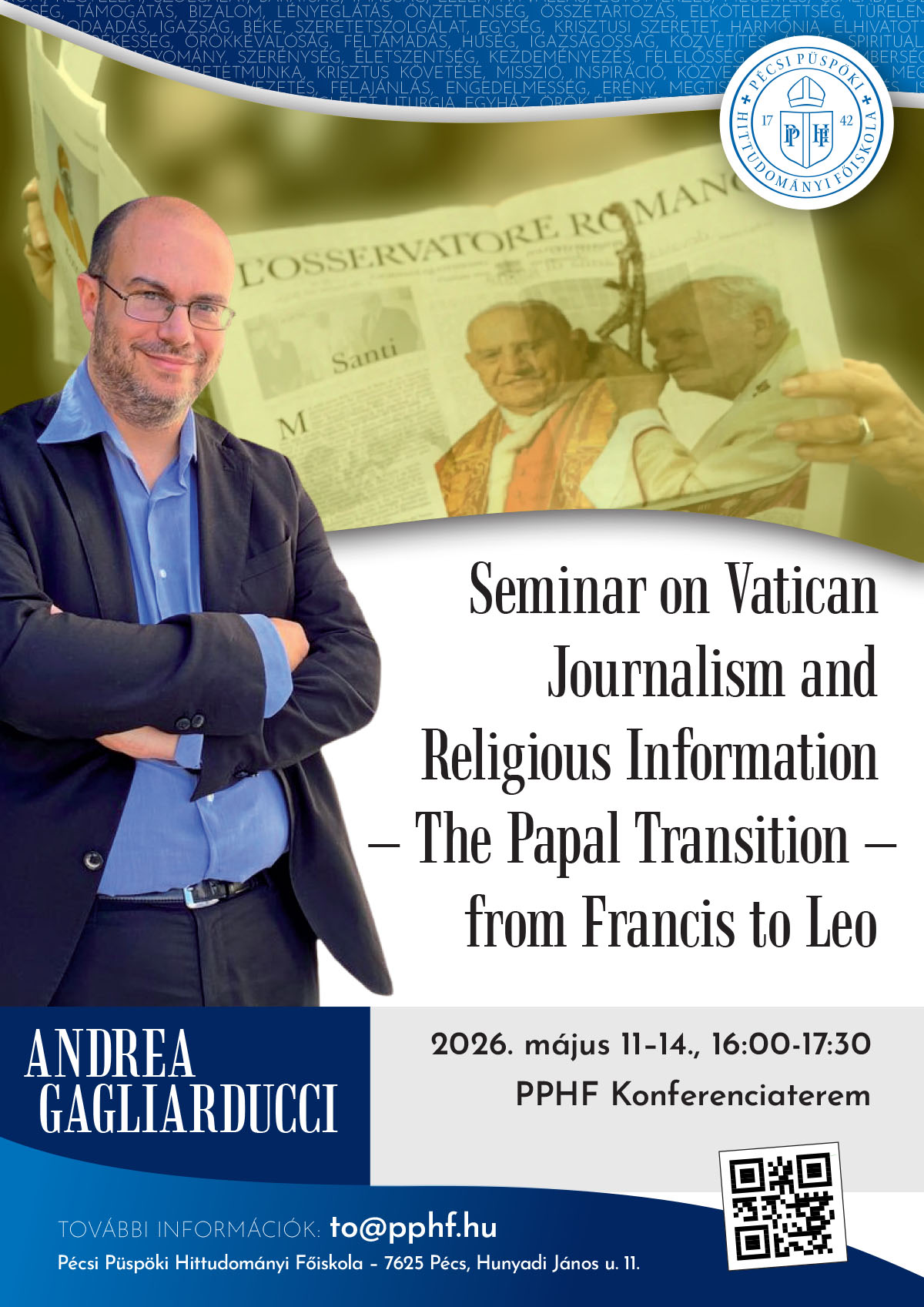
Andrea Gagliarducci újságíró, elemző, a Catholic News Agency és az ACI Stampa Vatikán-szakértője tart előadást főiskolánkon 2026. május 11-14. között.
Az előadó gazdag tapasztalattal rendelkezik a katolikus újságírás területén. Tanulmányait a Libera Università degli Studi Maria Ss. Assunta di Roma kommunikáció szakán végezte, az Istituto Universitario Sophián (Loppiano, Olaszország) folytatott doktori tanulmányainak témája az Európai Püspöki Konferenciák Tanácsának tevékenysége. Szakterülete a Vatikán diplomáciája és gazdasága, a Szentszék története, a pápai szertartások és a protokoll.
The death of Pope Francis on April 21, 2025, initiated the vacancy of the see, and all the procedures leading to the Conclave and the election of the new Pope. On May 8, 2025, the cardinals elected Robert Francis Prevost as the 266th successor of Peter. The new Pope took the name Leo XIV.
This seminar aims to explain how religious information should address the vacancy of the see and a new pontificate. The seminar will explore the topics to be addressed, the issues to be carefully considered, and the challenges a new pontificate brings.
The seminar will focus in particular on the perspective of religious information, to explain some information dynamics from the inside and understand how information can be considered truly successful.
The seminar will consist of four three-hour lectures, totaling 12 hours. Each lecture will present a specific case history and provide reading material for analysis.
Lesson 1 – On the Death of the Pope
What happens when a Pope dies? What are the details of the papal ceremonial and its meanings? How is a Pope’s funeral prepared?
The lesson will present a brief guide to the symbols and themes of the papal transition, accompanied by practical examples and images of Pope Francis’s funeral, as well as comparisons to other papal funerals throughout history.
Case history: the role of the Vatican Secretary of State during the sede vacante
Lesson 2 – The General Congregations
Cardinals from around the world gather in what are called general congregations and begin a reflection on the situation in the Church. How do cardinals meet? How do they understand the topics of discussion and how do they communicate them? What are the cardinals’ priorities? During the lecture, some of the reports released during the General Congregations by the Holy See Press Office will also be analyzed.
Case history: the Becciu case and the Pope’s posthumous letters
Lesson 3 – Towards the Election of the Pope
At the end of the General Congregations, the deceased Pope’s fisherman’s ring is broken, and the cardinals then prepare spiritually for the Conclave. The Conclave is a rite with specific symbolism. During the lesson, students will explore the symbolism of preparation for the Conclave and the significance of each gesture leading to the election of the new Pope.
Case history: the fisherman’s ring
Lesson 4 – The Election of the Pope
Leo XIV presented himself to the people of God with a precise speech, written and read with confidence. But has it always been the Church’s tradition for popes to address the crowd with a speech once elected?
During the seminar, the reconstructions of the election of Leo XIV will also be analyzed, and a „practical” model will be provided for understanding the cardinals’ choices in the Conclave and gaining a more general idea of how journalists work in understanding sources.
Case history: The assessment of the past pontificate and the prospects for the next pontificate
The teacher
Andrea Gagliarducci, a Vatican analyst for over 20 years, works for EWTN, the Italian-language news agency ACI Stampa, and the National Catholic Register. He also collaborates with various newspapers and magazines in both the secular and Catholic worlds. In Italy, he writes for the dailies Il Messaggero and Il Foglio. He is also a contributor to the Spanish magazine Alfa y Omega, the French magazine Cardinalis, and several other publications. He has written ten books. He is currently pursuing a doctorate in European Church History from the Sophia University Institute (Loppiano, Italy) and a doctorate in sociology of religions from the Pázmány Péter Catholic University (Budapest, Hungary). He writes a Saturday column, ” Pontifical Diplomacy, ” which covers all the Holy See’s diplomatic activities that week.